

Mathematics
CURRICULUM FRAMEWORK
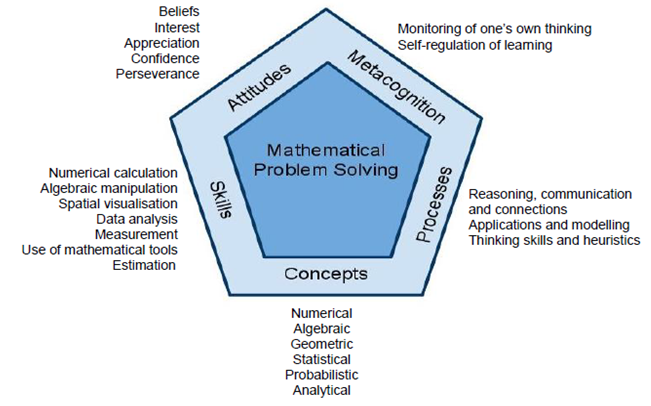
The central focus of Mathematics is mathematical problem solving. The framework sets the direction for and provides guidance in the teaching, learning and assessment of mathematics in our school.
CONCRETE-PICTORIAL-ABSTRACT (C-P-A) APPROACH
In the teaching and learning of mathematics, our school believes in building a strong foundation in the mathematical concepts in our students. Our students acquire mathematical concepts and skills using the Concrete-Pictorial-Abstract (C-P-A) approach. Students are given concrete experiences to help them develop their numeracy skills, make connections and subsequently become better problem-solvers.
KEY DEPARTMENT PROGRAMMES
LEARNING EXPERIENCES
Our students are exposed to a variety of learning experiences where they can apply and relate their knowledge of Mathematical skills and concepts to real-life experiences.
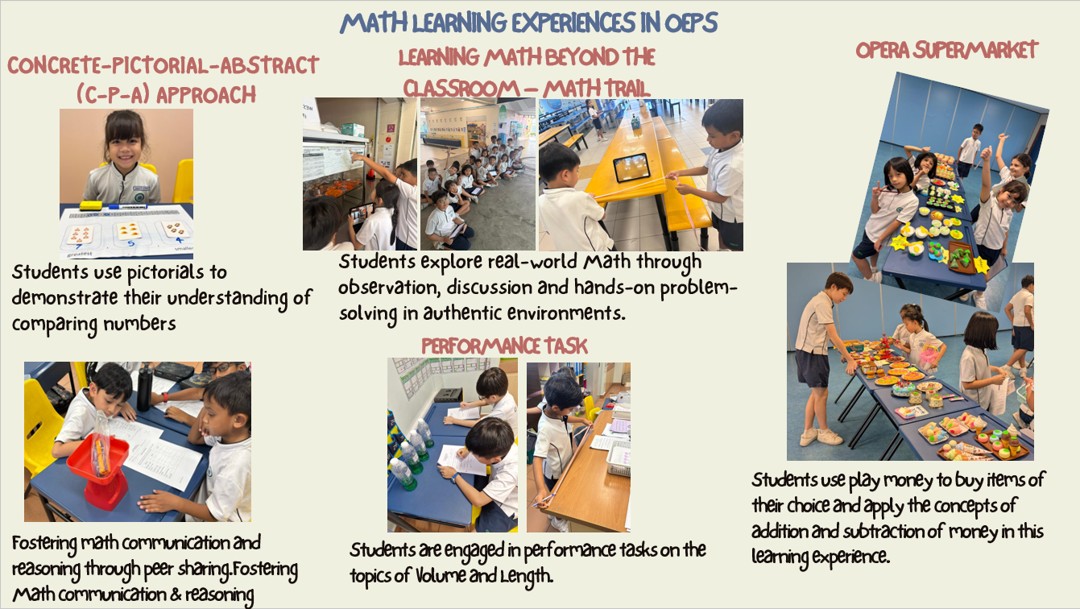
1) Mathematics all around us: OPERA SUPERMARKET P1 SHOPPING DAY
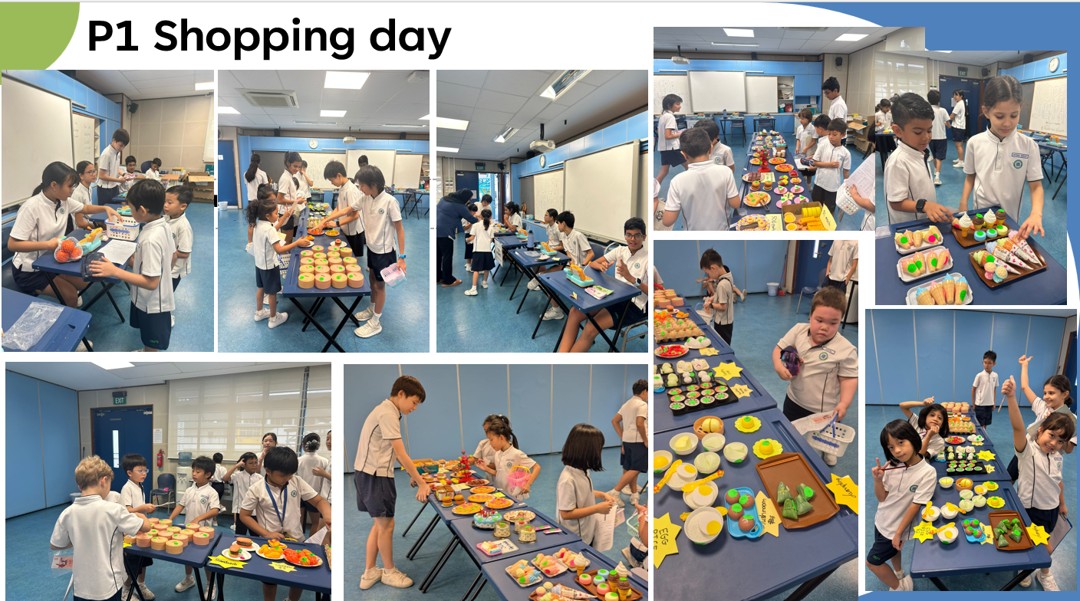
P1 Shopping Day: Bringing Learning to Life
Learning extends beyond textbooks and classrooms. Through our annual P1 Shopping Day, students are given the opportunity to apply what they have learnt in a realistic and meaningful context.
The school’s “Opera” Supermarket is transformed into a vibrant shopping environment where Primary 1 students take on the role of shoppers. Armed with a shopping list and a budget, they practise identifying items, comparing prices, making purchases, and calculating change. This hands-on experience allows students to apply their Mathematics skills while developing confidence in handling money.
Beyond numeracy, the activity also nurtures important life skills such as decision-making, responsibility, communication, and independence. Students learn to interact politely with others, follow instructions, and make thoughtful choices as they navigate the shopping experience.
By creating authentic learning opportunities, P1 Shopping Day helps students see the relevance of classroom learning in everyday life. We hope that this experience encourages parents to involve their children in simple real-world transactions, such as making purchases at shops or supermarkets, to further reinforce these valuable skills.
2. LEARNING MATHEMATICS BEYOND THE CLASSROOM
Lower Primary Math Trails
Who says Mathematics can only be learnt in the classroom? Through our Lower Primary Math Trails, students venture around the school to discover Mathematics in the world around them. From identifying shapes and patterns in the environment to measuring distances and collecting data, students engage in hands-on activities that bring mathematical concepts to life. These authentic learning experiences help students make meaningful connections between classroom learning and everyday surroundings, while nurturing curiosity, problem-solving skills, and a love for Mathematics.
MathPlay@Recess
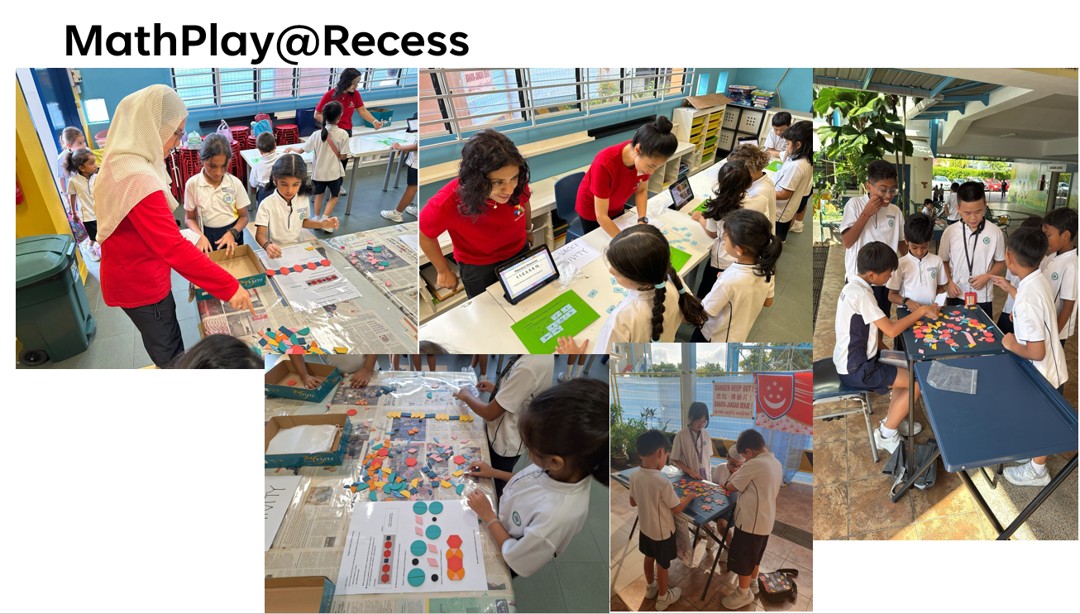
Who says learning Mathematics cannot be fun? Through MathPlay@Recess, students explore mathematical concepts through play during their recess breaks. From challenging themselves with Sudoku and Tangrams to enjoying Math board games and digital games designed by fellow OEPS students, students develop problem-solving, logical thinking, and spatial reasoning skills in an engaging and enjoyable way. By combining learning with play, MathPlay@Recess nurtures curiosity and helps students discover the joy of Mathematics.
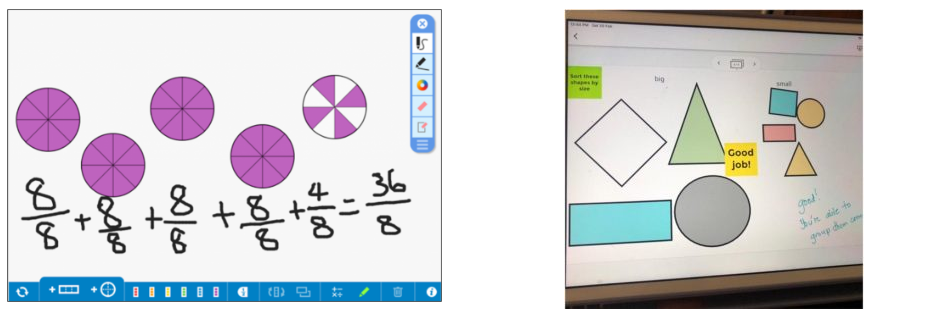
4. LEARNING MATHEMATICS WITH ICT
Students engage in learning experiences that incorporate the use of technology to allow them to demonstrate their understanding of the Mathematical concepts.
5. LEARNING JOURNEY

P3 Math and Science Learning Journey to the Zoo
Learning comes alive when students step beyond the classroom! During the P3 Math and Science Learning Journey to the Zoo, students explored the fascinating world of animals while applying concepts learnt in both subjects. Through hands-on activities and guided observations, they collected and analysed data, compared measurements, and investigated how animals are adapted to their habitats. The experience encouraged students to observe, question, and think critically, while helping them see how Mathematics and Science are connected to the real world around them.
6. LEARNING MATHEMATICS THROUGH STUDENT-DESIGNED GAMES

Students experience Mathematics in a fun and meaningful way through engaging games such as Operation Hopper and Equation Destination. Do you know that these games were created by our very own OEPS students for the PMPC competition? These creative ideas have since been redesigned into interactive Math games for their peers to enjoy both in and outside the classroom. Through these experiences, students not only strengthen their mathematical thinking but also learn from and be inspired by the creativity of their fellow students.
<img src="/images/2026/Math/math6.jpg">
SUPPORT PROGRAMMES
Early intervention programmes are provided to help support identified pupils address misconceptions, consolidate and reinforce their learning as well as build their confidence in the learning of Mathematics.
1. LEARNING SUPPORT FOR MATHEMATICS (LSM) PROGRAMME (P1- P4)
The Learning Support for Mathematics (LSM) programme provides early intervention for students who require additional support in developing foundational numeracy skills. Through engaging, hands-on activities and targeted instruction, students build a strong understanding of mathematical concepts while receiving individualised support in areas of need. Conducted in a small-group, conducive learning environment, the programme aims to strengthen students’ confidence and foster positive beliefs about their ability to learn and succeed in Mathematics.
<img src="/images/2026/Math/math7.jpg"><br>
2. REMEDIATION PROGRAMME (P4 – P6)
The after-school mathematics remediation programme aims to help identify pupils students who need additional support, reinforce and consolidate their learning so that they build and strengthen their foundation.
EXTENSION PROGRAMMES
In line with the school’s continual emphasis on enriching and developing students’ potential to their fullest, P5 and P6 students are identified to undergo Olympiad training programme to be equipped with the necessary Mathematical knowledge and repertoire of problem-solving and visual-thinking skills to solve higher-order and non-routine problems. Some of these competitions these students take part in include:
- Singapore Mathematical Olympiad for Primary Schools (SMOPS)
- National Mathematical Olympiad for Primary Schools (NMOS)
- Raffles Mathematical Olympiad (RMO)
1. E2K MATHEMATICS PROGRAMME (P4 and P5)
In this programme, selected P4 and P5 students will have the opportunity to develop their critical and analytical thinking as well as their problem solving skills through an inquiry approach. Students also develop 21st century competencies such as effective communication as they collaborate with their peers to work on puzzles, games and mathematical explorations that are specially designed for this programmme.
2. MATHEMATICS COMPETITIONS
Our students have the opportunity to participate in competitions to further extend their learning of mathematics beyond the classroom. Some of these competitions include the Primary Mathematics Project Competition (PMPC) and the Singapore Mathematical Olympiad for Primary Schools (SMOPS).
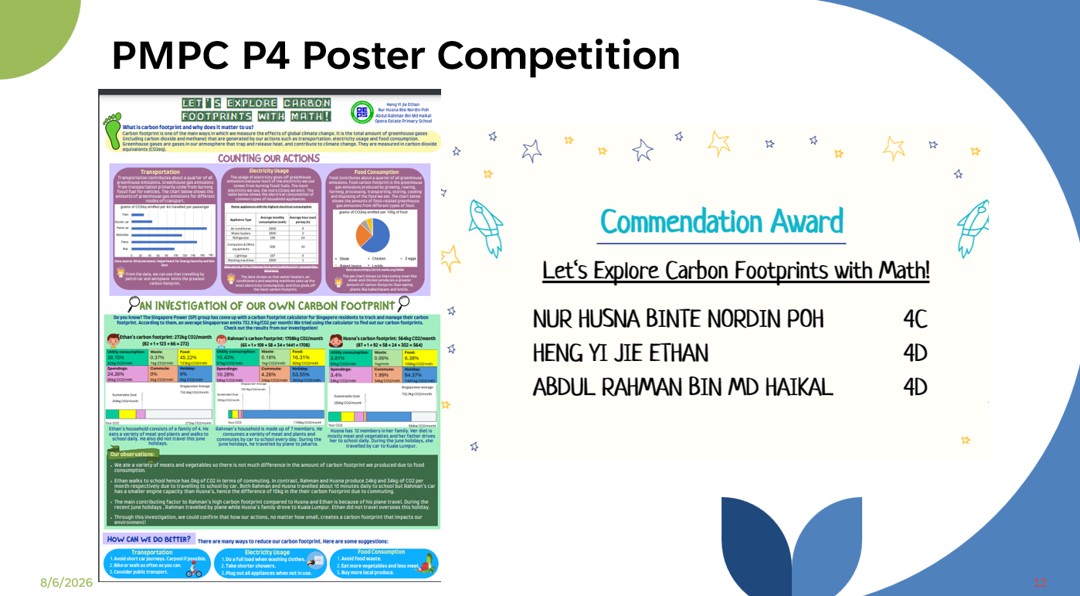
Our P4 team attaining the ‘Commendation Award’ in the Poster Category in the Primary Mathematics Project Competition (PMPC).
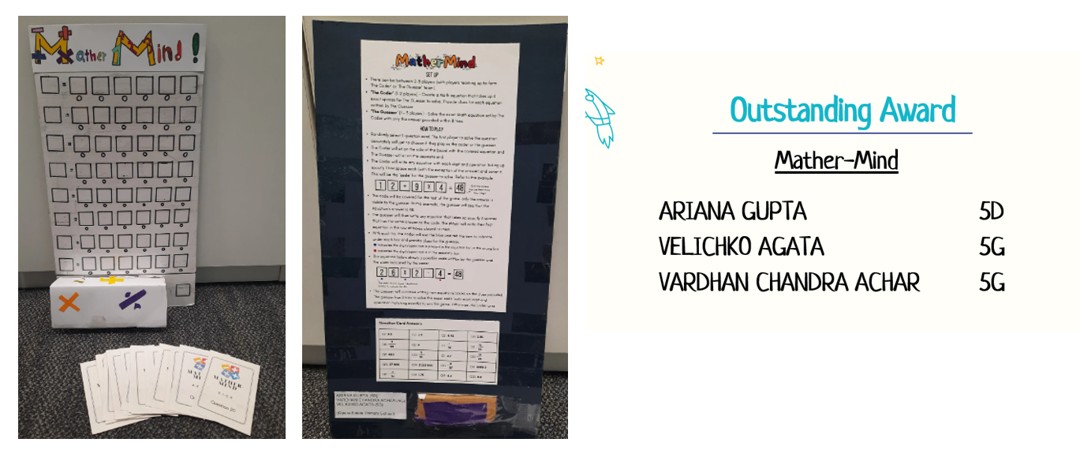
Our P5 team attaining the ‘Outstanding Award’ in the Game Creation Category in the Primary Mathematics Project Competition (PMPC).
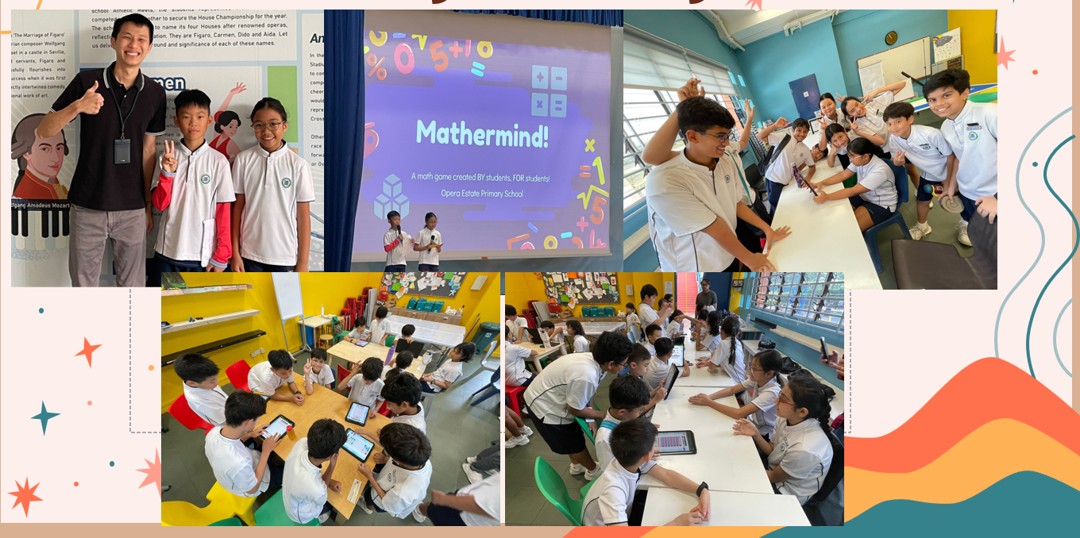
The game Mathermind was even redesigned as a digital Math game for all OEPS students to enjoy and engage with!